
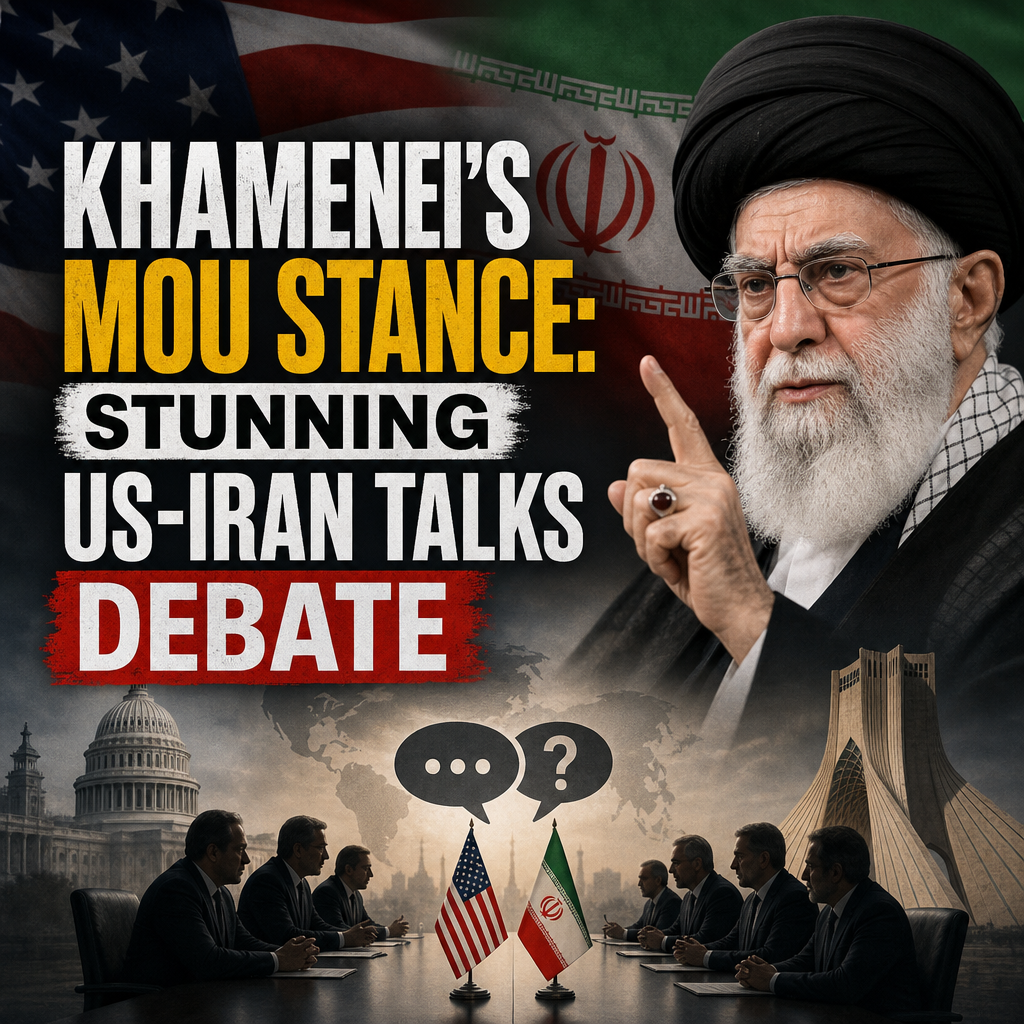
Khamenei’s MoU Stance: Stunning US-Iran Talks Debate


Khamenei’s MoU stance has reopened an old argument about whether the United States and Iran are inching toward diplomacy or simply managing another round of mistrust.
With Iranian and American officials meeting in Switzerland, the latest debate is less about one document than about what kind of political signal it sends. A memorandum of understanding can sound technical, even modest. But in the current atmosphere, every phrase tied to Iran’s nuclear file, sanctions pressure, or regional security is being read as a test of intent. That is why the reaction to Supreme Leader Ali Khamenei’s comments matters: they have turned a routine-sounding diplomatic idea into a broader argument about whether Washington and Tehran are serious about compromise or still trapped in strategic theater.



Why Khamenei’s MoU stance matters
At the heart of the dispute is a simple but difficult question: can the two sides agree on a framework without first rebuilding trust? Iranian officials are trying to signal that any engagement must respect sovereignty and avoid appearing like surrender. From that perspective, a memorandum may be acceptable only if it locks in practical limits and guarantees, rather than serving as a symbolic concession to Washington.
The American side, meanwhile, is reported to be approaching the talks with its own constraints. U.S. policymakers face domestic skepticism toward Iran diplomacy, especially after years of sanctions, failed negotiations, and regional escalation. That means any agreement has to look enforceable, not just hopeful. In that sense, the debate over an MoU is really a debate over credibility.




What makes the story more complicated is that both governments have incentives to keep talking even when they disagree publicly.
– Iran needs economic relief, or at minimum a reduction in pressure, to stabilize its domestic situation.
– The U.S. wants some mechanism to slow nuclear escalation and reduce the risk of a wider regional conflict.
– Both sides want to avoid being seen as the first to blink.
That mix often produces a familiar pattern: tough rhetoric at home, careful language in back-channel or third-party talks, and a lot of uncertainty in between.
The Swiss meeting: diplomacy or damage control?
The fact that the talks are taking place in Switzerland is itself revealing. Neutral territory has long been used when adversaries need a place that looks credible to both sides. But neutral ground does not guarantee neutral outcomes. It usually means the diplomacy is delicate enough that neither side wants to host it on the other’s turf.
Al Jazeera’s framing emphasizes the political sensitivity of Khamenei’s position and how it feeds into debate over whether Iran is opening a door or tightening its demands. That approach highlights a key reality: Iran’s internal messaging is never just about foreign policy. It is also about managing factions at home, some of which view concessions with deep suspicion.
RT’s coverage, by contrast, tends to foreground the role of U.S. pressure and the argument that Washington remains the main obstacle to a durable bargain. That perspective matters because it reflects a long-running Iranian complaint: that the U.S. asks for restraint while continuing sanctions and strategic pressure. Even when this view is contested, it helps explain why Iranian leaders frame negotiations as a matter of resisting coercion rather than seeking rapprochement.
Sky News, meanwhile, is likely to present the talks through a more security-focused lens, stressing the potential implications for regional stability, energy markets, and Western foreign policy. That angle is useful because it reminds readers that this is not just a bilateral dispute. Any change in U.S.-Iran relations affects Gulf security, shipping routes, proxy conflicts, and broader efforts to prevent another regional shock.
Taken together, those three angles suggest no single narrative is enough. This is not simply a story of breakthrough or breakdown. It is a story of competing definitions of diplomacy.
What each side is really trying to prove
The public statements around these talks are less about the fine print and more about leverage.
Iran is trying to prove that it will not negotiate under humiliation. The U.S. is trying to prove that it can still shape Iranian behavior without drifting into open-ended confrontation. Both are also trying to convince outside audiences — allies, rivals, markets, and domestic voters — that they are in control.
That leaves a narrow space for actual progress. If a memorandum is too vague, it risks becoming a public-relations exercise. If it is too detailed, it may collapse under the weight of red lines on both sides. That is why analysts often treat these early-stage talks with caution: they may be meaningful, but they are rarely decisive.
The most responsible reading of the moment is that the Swiss meeting shows willingness to communicate, not readiness to reconcile. That distinction matters. Communication lowers the risk of miscalculation. Reconciliation would require something far harder: a shared belief that each side can keep its word.
A fragile opening, not a final answer
The latest debate around Khamenei’s stance suggests that neither side has abandoned diplomacy entirely. That is important, because even imperfect dialogue can prevent escalation. But it would be premature to describe the talks as a turning point.
The deeper problem is structural. The U.S. and Iran are still negotiating from positions shaped by decades of mistrust, sanctions, military threats, and competing regional ambitions. In that environment, a memorandum of understanding is not just a legal or diplomatic tool. It is a test of whether either side can tolerate ambiguity long enough to build something sturdier.
For now, the clearest conclusion is also the most modest one: talks are happening, but trust is not. And until that changes, every statement from Tehran or Washington will continue to be read not as an endpoint, but as a signal in a larger and still unsettled contest.

























